FreeCell History: Origins, Evolution & Fun Facts


It is a fact that most people have, at some point, played FreeCell, but few are aware of its true story. It has not been on Windows for one day; it has a history that can be traced back decades.
The history of FreeCell reveals how a simple card game created by an individual came to be played on the computers of millions of people worldwide, and later it became one of the most well-known games, which you can now Play FreeCell online for free.
Table of contents
What Is FreeCell?

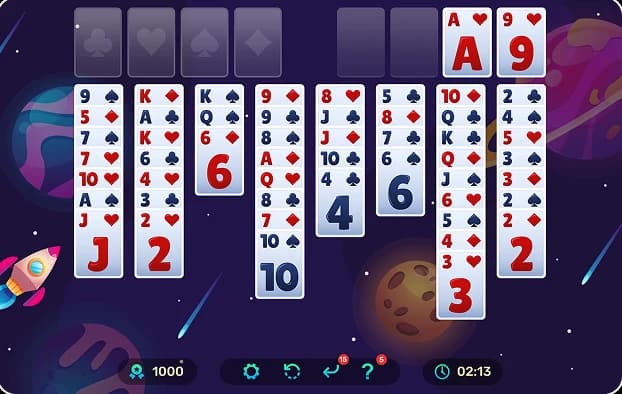
FreeCell is a card game played with a 52-card deck. The difference between it and most solitaire games is that the cards are laid face-up at the very beginning. Nothing is hidden.
This is the core of the freecell game: since you can observe all the cards, it is more about thinking and planning than luck. The objective is to clear all the cards into four foundation piles, each of which is a suit of Ace to King.
The Origin of FreeCell
FreeCell did not come out of nowhere. The origin of freecell goes back to older card games people played by hand. It grew mainly out of two games, the Eight Off FreeCell game and Baker's Game.
Baker's Game was introduced in 1968 by Martin Gardner in his Scientific American column. It used four free cells and had players build card sequences in the same suit. These freecell origins gave the game its basic shape before anyone ever put it on a computer.
The Creation of FreeCell by Paul Alfille
The history of freecell has one clear turning point: 1978. Paul Alfille was a medical student at the University of Illinois when he built the first computerized FreeCell on the PLATO educational computer system. He took Baker's Game and made one important change; instead of building cards in the same suit, he allowed alternating colors.
That single modification rendered practically every deal solvable and gave the game its name. His program was small, only 6 kilobytes, but it worked. It became popular on the PLATO network, and FreeCell began to spread.
FreeCell's Rise on Personal Computers
For years, FreeCell stayed within university networks. That changed in 1988 when Jim Horne, who had played FreeCell on PLATO, built a DOS version with color graphics. He joined Microsoft that same year and later brought the game to Windows.
FreeCell gained popularity when Microsoft included it in Windows 95 in 1995. Windows 95 was sold more than 40 million times in its first year, and that helped place FreeCell on computers in homes and offices all over the world. It was just present there, and most people did not bother to look.
The Famous Windows FreeCell Version
The Windows version had one feature that made it special: 32,000 numbered deals. Every number would yield the same layout on the card, so players could share some fun hands with their friends and play the game as many times as they wished.
In 1994, a volunteer team of more than 100 players decided to solve every one of the 32,000 deals. They finished in April 1995 and found that every single deal was solvable except one. The Freecell 11982 game could not be beaten, no matter what. It remains the most famous hand in solitaire history.
Microsoft later expanded the deal count to 1 million in Windows XP. Out of those million deals, only eight are unsolvable.
FreeCell in the Internet and Mobile Era
As the internet grew, FreeCell moved online. Solitaire websites let people play in their browser without needing Windows at all. Then smartphones came along, and FreeCell apps appeared on iOS and Android with extras like hints, stats,Freecell strategy and custom themes.
When Microsoft removed games from Windows 8 in 2012, users complained loudly enough that FreeCell was brought back in Windows 10 in 2015. It has been there ever since.
Today, the game runs on browsers, phones, tablets, and more. It went from a 6-kilobyte university program to one of the most played card games on the planet.
Why FreeCell Became So Popular
Skill-Based Gameplay
Every card is visible from the start, so losing is never about bad luck. It is always about the moves you make, and Different types of FreeCell versions kept it interesting. That keeps players coming back to figure out where they went wrong.
Simple Rules but Deep Strategy
The rules take a few minutes to learn. But playing well, knowing when to use a free cell, which cards to move first, and how to unblock buried cards, takes real thought. Easy to start, hard to master. That simplicity is a hallmark of great card design, one shared by many old card games that survived for centuries precisely because anyone could pick them up quickly.
Available Everywhere
FreeCell was already on your computer before you ever looked for it. No download, no cost, no setup. That built a massive audience through the 1990s, and the game carried those players straight into the mobile era.
Fun Facts About FreeCell
- Paul Alfille invented the first FreeCell in 1978 while a medical student. The program was just 6 kilobytes.
- Jim Horne made the first color DOS version in 1988 and later brought it to Windows at Microsoft.
- Microsoft has included FreeCell in every version of Windows since 1995.
- The original Windows version had 32,000 deals. Windows XP expanded this to 1 million.
- Only deal number 11982 is unsolvable out of the original 32,000.
- Out of the first 1 million deals, only 8 are are Unsolvable FreeCell games.
- FreeCell is estimated to be used more than Microsoft Word and Excel combined.
FAQs
- FreeCell was a development of older card games such as Baker's Game. It was converted into a computer game by Paul Alfille in the year 1978. It was then ported to Windows by Jim Horne, and when Microsoft made it part of Windows 95 in 1995, it became one of the most played video games in the world.
- FreeCell was developed by Paul Alfille at the University of Illinois's PLATO computer system in 1978. He changed the Game created by Baker, making it different so that card building would be done in alternating colors rather than the same suit, and this is what has made FreeCell the game it is at present.
- This was primarily due to Windows being sold by Microsoft alongside Windows 95, which sold more than 40 million copies in its first year. That made FreeCell available on more computers than any other game in history, at virtually no cost, and playable.
- Almost. Among all Microsoft deals, 32,000 are solvable, and deal 11982 is the only unsolvable one. Of the initial 1 million deals, only 8 cannot be won, and the chance of getting an impossible game is very low.
FreeCell.game vs Other FreeCell Websites: Best Comparison
FreeCell.game vs other FreeCell websites compared by speed, ads, mobile support, solvers, and numbered deals. Discover the best FreeCell site online.

Card Games vs Board Games: Which Trains Your Brain Better ?
Discover whether card games or board games provide better brain training for memory, focus, strategy, and problem-solving.
Why More People Are Switching From Offline FreeCell to Online Play
Find out why players are moving from classic desktop FreeCell to browser-based play and what online versions offer today.
Is FreeCell More Popular in the US or the UK? What the Data Says
Compare FreeCell popularity in the US and UK using search volume, per-capita data, and player interest.
Is Every Game of FreeCell Winnable? Strategy & Tips
Is every game of FreeCell winnable? Learn the truth behind FreeCell solvability, why most games can be won, and what makes some deals impossible.