Card Games to Play by Yourself: 14 Best Solo Options


Selecting the card games to play alone is the best way to keep your brain in shape while remaining entirely independent of others and even of the Internet connection. If you prefer not to stare at a screen anymore or just want to indulge in some solo activity, playing a game of cards will always be a fun choice.
It turns out that no matter if you play a fast-paced card game purely based on luck or a challenging card game with complicated rules, there’s plenty of exciting options to consider.
Below, you can discover the top 14 best single-player card games, divided into difficulty levels for all types of players. To practice your strategy or enjoy a quick match on the go, you can always play Freecell online through your browser.
Table of contents
Easy Card Games to Play by Yourself (Beginner-Friendly)
These games are ideal for starters. They are easy to understand, have high win rates, and take minimal time.
| Game Name | Difficulty | Skill vs. Luck | Best Feature |
|---|---|---|---|
| Klondike | Easy | Balanced | The all-time classic experience |
| Pyramid | Easy | Luck Heavy | Fast rounds and simple math |
| Golf | Easy | Skill Based | Quick pace with a sports-like feel |
| Clock | Easy | Pure Luck | Relaxing and meditative |
| FreeCell | Intermediate | High Skill | Almost every game is winnable |
| Spider | Intermediate | High Skill | Great for long-form strategy |
| Baker’s Game | Intermediate | High Skill | The challenging ancestor of FreeCell |
| TriPeaks | Intermediate | Balanced | Engaging, fast-moving layout |
| Double FreeCell | Intermediate | High Skill | Large scale play with two decks |
| Beehive | Intermediate | Balanced | Unique "garden" mechanic |
| Eight Off | Intermediate | High Skill | Extra cells for more breathing room |
| Canfield | Advanced | High Skill | A true test for Solitaire pros |
| 4-Deck FreeCell | Advanced | Extreme Skill | The ultimate endurance test |
| Scorpion | Advanced | High Skill | Rewarding complexity and depth |
1. Klondike Solitaire

The Klondike card game has been around forever, as far as single-player card games go. It is the standard Solitaire card game that ships with Windows. In this game, you have to move all your cards to four piles in ascending order according to the suit.
Mastering the Klondike solitaire set up is the first step, as you must arrange seven columns of cards with only the top card of each pile facing up. It is easy to learn but offers enough strategy to keep you coming back.
2. Pyramid Solitaire

Pyramid is a very distinctive solo card game. The cards are laid down in a pyramid. The object is to clear pairs of cards that total 13 (such as a 6 and a 7). Kings are 13 and can be removed on their own. This is a fast game and good for mental mathematics.
3. Golf Solitaire
Golf Solitaire is called so because your objective is to get the lowest "score" over a number of rounds. Cards are removed from the columns and placed in a single waste pile if they are one rank higher or lower than the top card of the waste pile. It is a game of momentum and really fun to complete the board.
4. Clock Solitaire
If you want a game that is almost 100% luck and doesn't require any in-depth tactical planning, then Clock Solitaire is the game for you. You have 12 piles of cards to represent the hours of the clock and one in the center. You draw cards and place them in their "hour". It's a soothing, relaxing game.
Intermediate Single-Player Card Games
If you've already got a handle on the basics, these are intermediate card games to play alone. These games have more "open" information, and you can see more cards and move ahead a few steps.
5. FreeCell Solitaire

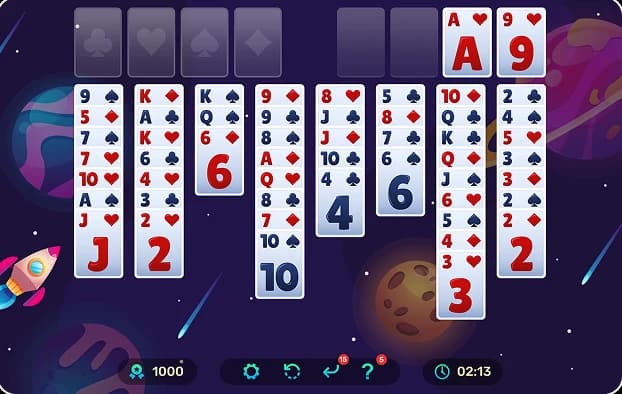
FreeCell is a popular solitaire game because almost all deals can be won. In contrast to Klondike, where you can be lucky or unlucky in the draw, FreeCell has four "open cells" to help you move cards. This allows for complex maneuvering and deep strategy. When considering, is playing Freecell good for your brain? In fact, the entire game depends mainly on what actions you take; with FreeCell, it is possible that you would end up losing the game due to poor play rather than poor shuffling.
6. Spider Solitaire

Spider Solitaire utilizes two decks of cards. The game requires the player to organize cards by suit in descending order from King to Ace. They can be moved away for convenience. The one-suit solitaire is easier, but the four-suit version is difficult type of solitaire.
7. Baker’s Game
Baker’s Game is the direct ancestor of FreeCell and is significantly harder. The rules are virtually the same except for the following caveat: You have to create sequences by suit (such as a nine of hearts onto a ten of hearts) instead of alternating colors. This small change makes it much more difficult to clear columns and move cards around. So first you need to understand how to play baker’s games.
Games like Baker's Game sit at the crossroads of modern solitaire and the old card games that inspired them, carrying centuries of card-playing tradition into a single-player format.
8. TriPeaks Solitaire

TriPeaks is a variation of Golf and Pyramid solitaires. There are three overlapping card peaks. To win, you remove cards that are one rank lower or higher than the card you have. The cards are overlapping, introducing a strategic element as you must choose which peak to "expose" first.
9. Double FreeCell
If a standard game feels too small, Double FreeCell uses two full decks of cards. You have eight foundation piles to fill and more columns to manage. It takes longer to play than the standard version but offers a massive sense of scale and complexity for those who have mastered the basic mechanics. It is also easy to understand the double freecell rules.
10. Beehive Solitaire
Beehive is a fast and small solitaire game. Cards are dealt into a "beehive" of 10 cards and six piles in a garden. The goal is to make a stack of four cards of the same rank. It is a good alternative to Solitaire if you don't have a lot of room.
11. Eight Off FreeCell
Eight Off is a popular variation that gives you more breathing room. Instead of four empty cells, you have eight. However, the King can be moved to a column with no cards, and sequences must be created by the card's suit, not by color alternation. This would be a good game for people who like FreeCell. Learning how to play Eight Off solitaire is straightforward: you deal the deck into eight piles and use your extra reserve cells to move cards around. While the extra cells help, you must build piles by the same suit, which requires careful planning to win.
Advanced Card Games to Play Alone (For a Real Challenge)
For those who find standard Solitaire too easy, these advanced options provide a steep challenge. Expect a lower win rate but a much higher sense of accomplishment.
12. Canfield Solitaire

Canfield was originally a gambling game in 19th century casinos because it is notoriously difficult to win. You start with a small reserve pile and a very limited tableau. The rules for building foundations are more restricted than in Klondike, requiring you to think five steps ahead to avoid getting blocked.
13. 4-Deck FreeCell
For the most dedicated players, 4-Deck FreeCell is the ultimate endurance test. Using 208 cards, this version requires intense focus and a large playing surface. If you are ready to tackle this giant, you can find specific 4-deck FreeCell rules and strategies to help you manage the massive number of sequences and foundations.
14. Scorpion Solitaire

Scorpion is a variant of Spider, where you can move any face-up card, regardless of whether it is covered by other cards. But cards can only go on a card of the same suit that is one rank higher. It takes a bit of concentration to avoid "burying" cards you might need later.
If you ever want to scale up the fun, the same strategic thinking you build here carries directly into 3 person card games.
Tips for Getting the Most Out of Solo Card Games
To improve your skills and enjoy these card games to play alone even more, keep these tips in mind:
- Prioritize face down cards: In games like Klondike, always prioritize moves that flip over face down cards to give you more options.
- Manage your empty spaces: In FreeCell or Spider, an empty column is your most valuable asset. Use it to rearrange sequences.
- Don't rush the draw: Before drawing from the deck, scan the board one last time. There is often a move you missed.
- Focus on the benefits: Beyond just fun, the benefits of playing card games include improved memory, better concentration, and a great way to relieve stress after a busy day.
These tips apply broadly because solo card games cover so many different types of card games, each with its own rhythm, rules, and mental demands.
Conclusion
Solo card games are a great way to keep your mind sharp and practice some self-care. Whether you like the simplicity of Klondike or the challenge of Scorpion, there's a single-player card game for you. All you need is a deck, a table and a desire to play. You may find solo play is just as fun as gathering with friends. And when you do want company, switching to 2 player card games for couples is always a natural next step.
FAQs
- The most common are Klondike Solitaire, FreeCell and Spider Solitaire. For a change, try Pyramid or TriPeaks for a different layout and quicker matches.
- Yes. You can play any of the above games with a deck of 52 cards. A few, such as Spider Solitaire, are even better with two decks.
- The easiest is probably Clock Solitaire since there's no strategy involved. Good games that take skill but are also easy to learn are Klondike or its variations.
- The word "Solitaire" is used to describe any single-player game, but there are games like Beehive, Golf, and Bowling that are not "stacking by suit" games.
FreeCell.game vs Other FreeCell Websites: Best Comparison
FreeCell.game vs other FreeCell websites compared by speed, ads, mobile support, solvers, and numbered deals. Discover the best FreeCell site online.

Card Games vs Board Games: Which Trains Your Brain Better ?
Discover whether card games or board games provide better brain training for memory, focus, strategy, and problem-solving.
Why More People Are Switching From Offline FreeCell to Online Play
Find out why players are moving from classic desktop FreeCell to browser-based play and what online versions offer today.
Is FreeCell More Popular in the US or the UK? What the Data Says
Compare FreeCell popularity in the US and UK using search volume, per-capita data, and player interest.
Is Every Game of FreeCell Winnable? Strategy & Tips
Is every game of FreeCell winnable? Learn the truth behind FreeCell solvability, why most games can be won, and what makes some deals impossible.