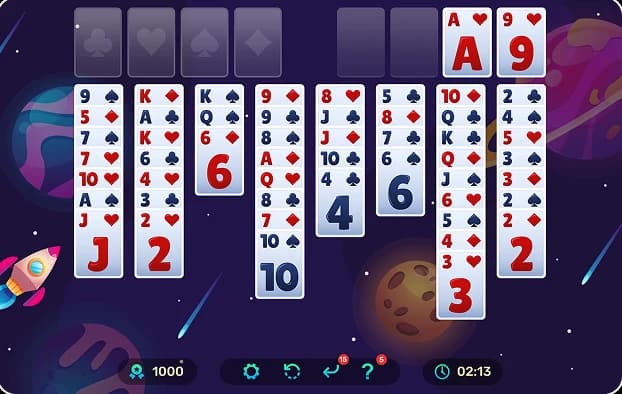
Why Baker’s Solitaire Is Harder Than You Think

Baker’s Solitaire is a difficult Freecell variant with lots of similarities. At first glance, you can’t easily spot it, but a major difference is that it requires a different level of skill. Players who attempt the game expecting a familiar experience are often disappointed. The suit-based stacking, stricter rules, and limited movement options are mind-boggling. Winning requires patience, practice, and a vast understanding of your strategy. Let’s give you a proper rundown.
Table of contents
Baker’s Solitaire vs. Freecell
While Baker solitaire succeeds Freecell and is quite a freecell alternative, certain key differences drift them apart. In Freecell, players have more flexibility in stacking cards by alternating colors. Baker's requires suit stacking in ascending order, hence fewer moves for your gameplay. This lack of flexibility pushes players to think carefully and strategically about every possible move. Also, wrong moves in Freecell can be easily recovered compared to Baker’s; the player would be punished.
Thanks to the ease of winning, Freecell is more popular and often the best option for newbies than Baker's. However, with players wanting a more gratifying and thrilling experience, Baker’s is sorted after. Both games still have the same objective: moving all 52-cards in ascending order, Ace to King, to the four foundations.
How Free Cells Work in Baker’s Solitaire
As mentioned earlier, Baker’s Solitaire has fewer moves; hence, every move is crucial. Free cells are open and vital to your gameplay; utilizing them could be challenging. You can place any card in them, but must be cautious about overusing these cells. Also, using them too early could jeopardize your gameplay. Most players get stuck when they have quickly used up the freecells. In Eight Off FreeCell, this same principle applies but with eight free cells available instead of four, which gives players noticeably more room to breathe while still demanding the same careful suit-based thinking.
Dealing Cards
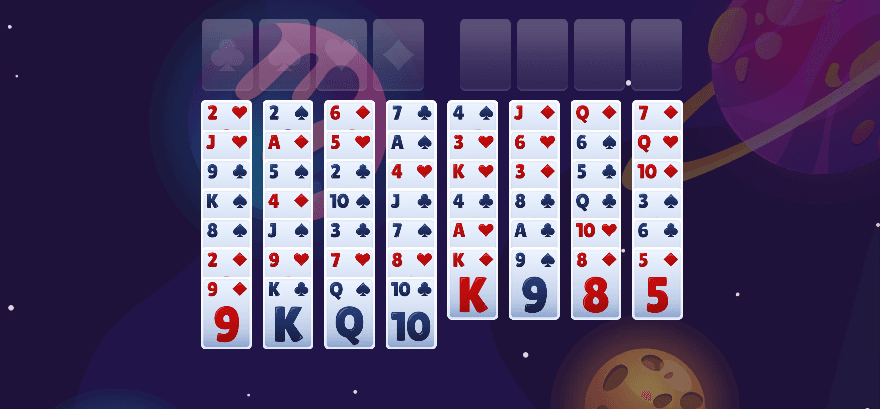
The Baker’s game is played using a standard card deck. There are 8 tableau columns, 4 free cells, and 4 foundation piles. The game starts with cards distributed across the 8 tableaus. Four tableaus are stacked with 7 cards each, while the remaining four are stacked with 6. The foundation pile and free cells are left empty. The layout is deceptively simple but needs careful management to manage.
Moving Cards in Baker’s Solitaire
Movement rules are not complicated but strict. Cards are stacked by suit in an ascending pattern in the foundation pile. Movement is restricted to one card per time. You can’t easily manipulate the tableau. If you move a card from one tableau to another, the card has to be of the same suit and one rank lower. Free cells take one card each, and any card can be moved to them.
Any card can be moved to an empty tableau column. Empty columns and free cells raise your chances of maneuvering or repositioning sequences. Quick moves to fill up free cells often lead to dead ends; you should leave them open as much as possible, offering you more flexibility in the game. For instance, moving the King to any free cell means you can only bring the card back to an empty tableau.
Winning the Game
The game’s objective is for players to move all 52 cards to the four foundation piles by suits. Doing this gets you the prize. Each foundation is built in an ascending order from Aces to Kings. While maneuvering in the tableau columns and free cells, carefully move cards appropriately to avoid being stuck. Move Aces to the foundation as soon as possible and build up the sequencing. When an important card or cards with small value are stuck, it becomes messy, possibly leading to zero movement. Free cells should be used when you can’t initiate any moves, and Kings should be moved to free cells carefully.
How to Handle an Overcrowded Tableau in Baker’s Solitaire

Poor tableau management is a drawback to your sequencing and winning. At every opportunity, move cards with lower value to the foundation piles. Begin with your Aces and build down to the Kings. Ensure you always have a free cell for maneuvering. Don’t move cards impromptu; you will end up without many moves. While building your tableau, ensure your sequencing is in descending order. With that, you can always move them to the foundation. However, if your situation becomes unmanageable, you may need to backtrack, restructure, or use the undo button.
Try Baker’s and Conquer the Game!
Baker’s Solitaire is difficult, but becoming proficient in it is satisfying. When you master the sequencing, you become unstoppable. The game rewards foresight, patience, and strategic planning. Practicing is a good way of honing your skills. Try the FreeCell strategies you have learned here. Be free and approach the game, expecting to always find a way out. Once you conquer Baker’s Solitaire, every win feels well-deserved.
FAQs
- Baker’s Solitaire is harder because it requires stacking cards by suit instead of alternating colors, allowing fewer moves. This restriction demands more careful planning and limits recovery from mistakes.
- While both games share similar layouts and goals, Freecell allows alternating color stacking, making it easier to recover from errors. Baker’s Solitaire, however, requires same-suit stacking and stricter move rules, increasing difficulty.
- In Baker’s Solitaire, cards must be stacked by suit and in ascending order on the foundation piles. Only one card can be moved at a time, and tableau movements must follow suit and rank order.
- Free cells act as temporary storage spaces where any single card can be placed. However, overusing them too early can trap your cards and block progress, so strategic timing is crucial.
- The game starts with 52 cards distributed across eight tableau columns — four with seven cards and four with six cards each. The four foundation piles and four free cells begin empty.

FreeCell.game vs Other FreeCell Websites: Best Comparison
FreeCell.game vs other FreeCell websites compared by speed, ads, mobile support, solvers, and numbered deals. Discover the best FreeCell site online.

Card Games vs Board Games: Which Trains Your Brain Better ?
Discover whether card games or board games provide better brain training for memory, focus, strategy, and problem-solving.

Why More People Are Switching From Offline FreeCell to Online Play
Find out why players are moving from classic desktop FreeCell to browser-based play and what online versions offer today.

Is FreeCell More Popular in the US or the UK? What the Data Says
Compare FreeCell popularity in the US and UK using search volume, per-capita data, and player interest.

Is Every Game of FreeCell Winnable? Strategy & Tips
Is every game of FreeCell winnable? Learn the truth behind FreeCell solvability, why most games can be won, and what makes some deals impossible.