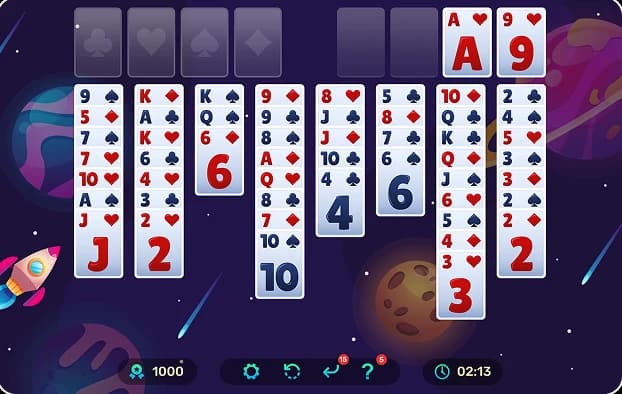
FreeCell Fewest Moves: How Low Can You Go?


FreeCell is the top solitaire game where players try for the fewest moves in FreeCell to see how low they can go. Expert players hunt FreeCell with the fewest moves possible, turning normal wins into real skill shows.
Smart computer tools show 99.99% of billions of card setups can be won with good plans; you can even Play FreeCell Online for Free anytime. This makes freecell fewest moves the best way to prove you are great at it.
Table of contents
- What Is the Fewest Moves in FreeCell?
- Is There a One-Move FreeCell Game?
- How Many Cards Can You Move in FreeCell?
- What Is the FreeCell Game With the Fewest Moves?
- MobilityWare FreeCell Fewest Moves Explained
- How to Finish FreeCell in Fewer Moves
- Does Fewer Moves Mean Better Strategy?
- Common Mistakes That Increase Move Count
What Is the Fewest Moves in FreeCell?
In FreeCell, the fewest moves in FreeCell tallies every card shift, whether to free cells, tableau columns, or foundation suits. How to Win FreeCell Games with optimal play means blending long runs and precise sequencing for an average of around 45 moves, depending on the layout.
Every day players land between 50 and 100, yet the least amount of moves in FreeCell emerges from leveraging empty spaces for supermoves, slashing redundant taps dramatically.
Is There a One-Move FreeCell Game?
A genuine one-move FreeCell Game defies the game's core design, as 52 cards scatter across eight columns, requiring sequential foundation builds from Ace to King by suit. Digital apps sometimes mislead with auto-complete that bundles final stacks into a single action, but manual execution demands exposing low cards and chaining dozens of transfers first. Even ultra-rare layouts that expose multiple Aces require more than one relocation.
How Many Cards Can You Move in FreeCell?
The Basic Rule
At its simplest, under standard FreeCell Rules, how many cards you can move in FreeCell boils down to one card onto a descending, alternate-color spot in the tableau or an eligible foundation pile.
Moving Card Runs Using Free Cells
Empty free cells amplify this: the formula caps movable cards at the number of empty free cells plus one, enabling two-card runs with one empty slot or five with all four free. This mechanic rewards foresight, turning isolated cards into bundled progress.
Using Empty Tableau Columns
Unlock exponential power via empty columns: maximum cards equals (empty free cells + 1) multiplied by 2 raised to the power of empty columns. In a typical FreeCell Setup, zero columns and four free cells allow five cards; introduce one empty column for a leap to 10, reshaping the board's flow.
Example – Can You Move a Run of 6 Cards?
Absolutely, achieving a move of 6 cards in FreeCell demands setups like two empty free cells paired with one empty column, yielding (2 + 1) × 2^1 = 6 cards. Envision parking temporary singles in free cells, evacuating a column, then gliding a perfect descending alternate-color sequence, say, heart of 7-8-9-10-J-Q onto its accepting King in one fluid operation.
Example – Can You Move a Run of 7 Cards?
A move-and-run of 7 cards as a group makes FreeCell feasible with configurations such as three empty free cells and one empty column, totaling (3 + 1) × 2^1 = 8 cards, great for seven. Alternatively, one free cell and two columns nets the same via (1 + 1) × 2^2 = 8; methodically stash blockers aside, clear paths, and deploy the run to cascade space below.
What Is the FreeCell Game With the Fewest Moves?
Legendary FreeCell games with the fewest moves hail from Microsoft FreeCell numbered seeds, like 15924803 or 17182509, unlike the rare FreeCell Unwinnable Games. Cracked by solvers in a mere 13 moves through early Ace reveals and chained supermoves. These outliers from the original 32,000 deals highlight layout variance, with modern generators unearthing similar low-move gems up to 20 steps.
MobilityWare FreeCell Fewest Moves Explained
MobilityWare FreeCell fewest moves logs each deliberate tap as a single count, treating multi-card supermoves identically regardless of scale to emphasize raw decision quality. Distinct from time-penalized scoring, this metric spotlights tap economy, where leaderboard elites flaunt sub-50 tallies through unrelenting optimization.
How to Finish FreeCell in Fewer Moves
The Best Strategy for FreeCell starts with these core tips:
- Plan Before Moving: Survey the tableau for Aces, deuces, and extended runs before committing, prioritize foundation launches to unlock cascades early.
- Keep Free Cells Open: Treat free cells as premium real estate; reserve them for pivotal holds to amplify your run-moving horizon.
- Avoid Breaking Useful Sequences: Preserve intact descending alternates unless dismantling yields superior gains elsewhere on the board.
- Minimize Temporary Moves: Cycle cards through free cells swiftly, avoiding permanent squatters that throttle momentum.
- Use Undo to Optimize: Experiment boldly with undos, refining paths to excise wasteful detours and polish toward minimalism.
Does Fewer Moves Mean Better Strategy?
Pursuing fewer moves elevates strategy to an art of zero-waste precision, often at odds with sheer win rates, where cautious shuffling secures victory beyond 100 steps. Competitive circles blend velocity with economy, but sub-50 chases define virtuosity for the dedicated. It separates casual solvers from layout whisperers.
Common Mistakes That Increase Move Count
- Opting for single-card nudges over viable runs, inflating counts needlessly.
- Clogging free cells prematurely, handcuffing multi-card potential.
- Overlooking the doubling effect of empty columns on mobility.
- Fragmenting promising sequences without a clear payoff.
Master the art of FreeCell, with the fewest moves to turn every game into a personal best. Start practicing today and discover just how low you can go.
FAQs
- Optimal play across random deals averages 45 moves, but elite layouts like Microsoft seeds 15924803 drop to 13 through flawless supermove chains. Humans rarely match this without solver aid, landing closer to 50 with practice.
- The ceiling hinges on (empty free cells + 1) × 2^(empty columns), scaling from a one-card baseline to 20+ in ideal conditions. Mastering this formula lets you bulldoze board states efficiently.
- Yes, two empty free cells and one empty column suffice via (2 + 1) × 2 = 6, provided the run descends alternately in color. Position temporary cards strategically first to enable this powerhouse shift.
- Certainly, three empty free cells with one column hits (3 + 1) × 2 = 8, covering seven; alternatives like one free cell and two columns work similarly. It demands meticulous space management upfront.
- No legitimate layout allows a single move to victory, given cards' initial scatter, which demands full suit assemblies from Ace up. App auto-completes mimic this illusion after the foundation buildup, but true play requires extensive maneuvering.

FreeCell.game vs Other FreeCell Websites: Best Comparison
FreeCell.game vs other FreeCell websites compared by speed, ads, mobile support, solvers, and numbered deals. Discover the best FreeCell site online.

Card Games vs Board Games: Which Trains Your Brain Better ?
Discover whether card games or board games provide better brain training for memory, focus, strategy, and problem-solving.

Why More People Are Switching From Offline FreeCell to Online Play
Find out why players are moving from classic desktop FreeCell to browser-based play and what online versions offer today.

Is FreeCell More Popular in the US or the UK? What the Data Says
Compare FreeCell popularity in the US and UK using search volume, per-capita data, and player interest.

Is Every Game of FreeCell Winnable? Strategy & Tips
Is every game of FreeCell winnable? Learn the truth behind FreeCell solvability, why most games can be won, and what makes some deals impossible.