How to Play FreeCell Solitaire: Rules & Tips


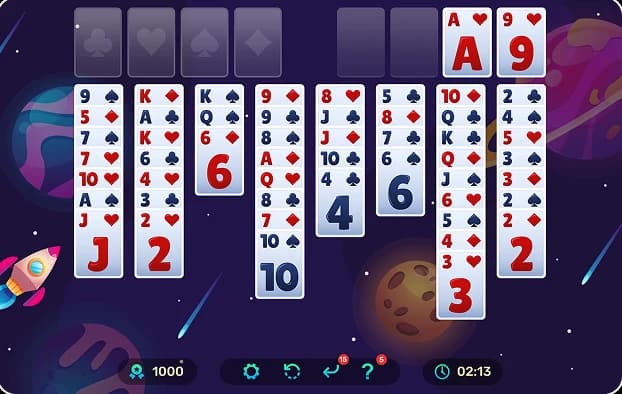
FreeCell Solitaire is a 52-card game in which cards are dealt entirely face-up across 8 tableau columns. The objective is to move all cards from Ace to King, by suit, to the 4 foundation piles. Players use 4 open reserve cells for temporary card storage and build tableau sequences in descending order by alternating colors.
Those that look easy to learn are always difficult to master. Millions of people Play FreeCell Online and physically, too. Once you understand the setup and rules, you will get the craze. Unlike classic solitaire, almost every FreeCell deal is solvable with the correct moves.
Table of contents
- How to Set Up FreeCell Solitaire Card Game and What Are the Rules
- The 3 Core Playing Areas in FreeCell
- Official FreeCell Rules & Card Movement
- FreeCell Rules vs. Klondike Solitaire: Key Differences
- Step-by-Step Guide: How to Play FreeCell
- FreeCell Strategy Tips for Beginners
- Playing FreeCell Online and the Advantages of Its Digital Versions
- Conclusion
How to Set Up FreeCell Solitaire Card Game and What Are the Rules

There are steps to set up FreeCell on the table and rules you need to follow to play it fair and square, making this guide a complete FreeCell Game Explained for beginners and casual players.
What You Need To Set Up a FreeCell Game
For that, you need to know how to set up FreeCell.
- Standard 52-card deck
- FreeCell's online version saves time by automatically shuffling and dealing the cards.
Step-by-Step FreeCell Setup Process
- Shuffle the deck well.
- First 4 columns: Deal 7 cards each (28 cards total).
- Last 4 columns: Deal 6 cards each (24 cards total).
- Leave 4 free cells empty above the columns.
- Leave 4 foundation spots empty below the columns.
- Total: 52 cards in 8 columns + 4 empty free cells + 4 empty foundations.
The 3 Core Playing Areas in FreeCell
There are three main areas in this game:
The 4 Free Cells (Top-Left)
Four open spaces at the top. Each holds one card temporarily.
Not "each card is temporarily held by four spaces”, it's 4 spaces, 1 card each.
The Tableau (8 Cascades)
Eight columns in the middle with all 52 cards dealt face-up at the start.
The first 4 columns get 7 cards each; the last 4 get 6 cards each.
The 4 Foundation Piles (Top-Right)
Four suit-specific target piles built up in ascending order from Ace to King to secure your final victory.
Official FreeCell Rules & Card Movement

There are different Types of FreeCell solitaire rules, and through this, you will understand it quite easily.
Objective of the Game
The goal of FreeCell is very simple: all four suits must be built (hearts, diamonds, clubs, spades) in the foundation piles, if arranged in ascending order from Ace to King.
How to Move Cards
If the cards are placed in alternating colours, such as red or black, the cards must be moved within the tableau.
Unless you don't have free cells and empty tableau spaces to allow for longer sequences, only one card can be moved at a time.
Rules for Free Cells and Empty Tableau Columns
Free Cell rules can act as temporary storage spots: The space tableau can be free up in each free cell.
Powerful empty tableau columns: to create flexibility, any single card or sequence can be moved.
Building Sequences in Tableau
By moving cards, you can build the sequence into the opposite colour and descending rank (e.g., black 7 on red 8).
Winning Conditions
When all four foundation piles are completed from Ace to King, you win. With the right strategy, these FreeCell solitaire rules ensure you to win Every Game is easy to solve.
The Multi-Card "Supermove" Formula
While physical cards are traditionally moved one at a time, digital engines allow you to move entire alternating-color sequences at once via "Supermoves." You can calculate how many cards you can move simultaneously using this standard formula:
MovableCards=(FreeCells+1)2EmptyColumns
For example, with 2 empty free cells and 1 empty tableau column, a player can move (2+1)21=6cards simultaneously. To learn more about advanced sequencing tactics, check out our detailed blog on the freecell strategy.
FreeCell Rules vs. Klondike Solitaire: Key Differences
| Feature | FreeCell Solitaire | Klondike Solitaire |
|---|---|---|
| Card Visibility | 100% Face-Up (All 52 cards visible) | Mostly Face-Down (Hidden rows) |
| Stockpile / Waste | None (Entire deck in play at start) | Yes (Draw 1 or Draw 3 stockpile) |
| Reserve Cells | 4 Free Cells | None |
| Tableau Building | Descending, alternating colors | Descending, alternating colors |
| Empty Column Filling | Any single card or valid sequence | Kings only (or King sequences) |
| Solvability Rate | 99.999% of deals | 10–15% casual human win rate |
Step-by-Step Guide: How to Play FreeCell
If you want to know about how to play FreeCell solitaire card game with practice tips, let’s delve deeper.
Initial Moves: Freeing Aces and Low Cards
First, start with low-numbered cards by uncovering Aces. It is helpful to build an early foundation. Start by uncovering Aces and low-numbered cards.
Using Free Cells Strategically
To maximise your moves, don’t fill them all at once. Think of free cells as your ‘backup space’.
Moving Sequences
To move longer sequences, it can only be moved if you have enough free cells or empty columns. Here is the formula to let you remember how to Win FreeCell by applying this formula.
Number of cards you can move = (free cells + 1) × (empty columns + 1).
Clearing Columns to Create Mobility
Always prioritise clearing the entire tableau column throughout. To organise sequences more effectively, an empty column offers great mobility.
Don’t fret when you get stuck. Remember, FreeCell solitaire- How to play effectively depends on planning multiple moves ahead of time.
FreeCell Strategy Tips for Beginners

Any beginner who started playing FreeCell Should Learn the Strategy and also some of the tricks. We listed some beginner-friendly strategies to make things easier for you.
- Keep free cells open. always: It may limit your options if you fill all four free cells too early.
- Prioritising empty columns is a must: filled ones take up more free space than empty ones.
- Multiple moves ahead must be planned: Some extra moves in advance will be great. Don’t just stick to two or three moves.
- Low cards must be covered early: this is a great tip for building the foundation faster. It allows it to be.
- Some common mistakes must be avoided: Trapping low cards under high ones can be tricky; don’t waste free cells unnecessarily.
Beginner FreeCell Tips for Quick Wins
- Maintain at Least 2 Open Free Cells: Avoid filling all four reserve slots early; full cells reduce your movement capacity down to just one card at a time.
- Follow the Safe Auto-Play Rule: It is always safe to move Aces and 2s to foundations immediately. Only delay higher cards if they are needed as stepping stones in the tableau.
- Empty Columns Are Power Assets: Prioritize clearing an entire column over clearing a single free cell, because empty columns double your multi-card movement power.
Playing FreeCell Online and the Advantages of Its Digital Versions

Playing FreeCell Online gives you unlimited games, undo buttons, move hints, and automatic setup, making it faster and easier than physical cards.
How to Play FreeCell Online for Free
You will find many websites and apps that let you practice how to play FreeCell online instantly. You can play solo, track your stats, or even compete with others.
Advantages of Digital Versions
- You can undo moves: It is perfect for learning without causing any frustration.
- Trackers, along with hints: The possible moves can highlight online FreeCell games.
- Easy accessibility: no deck is required; play anytime, anywhere.
Playing FreeCell digitally provides the same excitement as playing Solitaire, and when comparing FreeCell vs Solitaire, many players prefer FreeCell for its reduced reliance on luck and deeper strategy.
Mobile Apps & Websites to Practice FreeCell Solitaire
Popular FreeCell platforms like SolitaireBliss, Solitaire, and Skillz games can help you learn and make it easy to apply your skills.
Conclusion
Usually, learning games are not that easy to learn, but learning how to play FreeCell is a bit different. For that, you need to know how to Set Up FreeCell Properly before learning the rules and strategies. Make sure you use your free cells wisely. Remember, it requires immense patience to master it; don’t hurry up. Follow the strategy, foresight, and rules.
The overall experience is both fun and mentally stimulating, whether you are exploring how to play FreeCell solitaire with cards or trying a digital version. Both are great at engaging the player. And if you’re interested in more, explore the Benefits of FreeCell: Boost Your Mind and Focus Today to see how these classic games can improve your concentration and cognitive strength.
FAQs
- Starting from Ace to Kings, the main goal is to build all the cards into four foundation piles.
- Yes, it is mandatory to follow the strategies to play FreeCell if you get through the losses, which include keeping free cells open, clearing tableau columns while also uncovering low cards early.
- If you want to play FreeCell online, start with an online version to get better. When you master it, then try the physical deck when you get comfortable.
- There is a simple theory: if you can’t make more moves, the game ends. But online Freecell rules have a benefit that you can have ‘undo’ and ‘restart’ options.
- A. The simple rules state that all 52 cards need to be moved to the four foundation piles from Ace to King based on their suits. In the tableau, you have to build descending sequences of cards in alternating colors, making use of four free cells.
- A. You can move multiple cards at once by utilizing empty free cells and empty tableau columns as temporary storage. The total number of cards you can shift in a single turn depends directly on how many open free cells and blank columns you currently have available.
- A. Yes. Unlike Klondike solitaire, where only Kings can fill blank spaces, FreeCell allows you to place any single card or a valid descending alternating-color sequence into any completely empty tableau column.
- A. Computer analyses prove that roughly 99.999% of all randomly generated FreeCell deals are entirely winnable with optimal play. Only a tiny fraction of specific deals are mathematically impossible to solve.
FreeCell.game vs Other FreeCell Websites: Best Comparison
FreeCell.game vs other FreeCell websites compared by speed, ads, mobile support, solvers, and numbered deals. Discover the best FreeCell site online.

Card Games vs Board Games: Which Trains Your Brain Better ?
Discover whether card games or board games provide better brain training for memory, focus, strategy, and problem-solving.
Why More People Are Switching From Offline FreeCell to Online Play
Find out why players are moving from classic desktop FreeCell to browser-based play and what online versions offer today.

Is FreeCell More Popular in the US or the UK? What the Data Says
Compare FreeCell popularity in the US and UK using search volume, per-capita data, and player interest.

Is Every Game of FreeCell Winnable? Strategy & Tips
Is every game of FreeCell winnable? Learn the truth behind FreeCell solvability, why most games can be won, and what makes some deals impossible.