How to Play Baker’s Game Solitaire (Rules Explained)


In case you want to know how to play Baker game solitaire, then you are in the right place, since it is not easy to learn the rules as the classic FreeCell game, because it is more challenging.
Today, many players enjoy the game digitally and play Baker's Game Solitaire on the FreeCell Online Website or apps, as it allows them to practice strategies and playanytime.
Table of contents
- What Is Baker’s Game Solitaire
- Baker’s Game vs FreeCell
- Why Baker’s Game Is Considered a Skill-Based Game
- Objective of Baker's Game
- Baker’s Game Setup Explained
- Baker’s Game Layout Diagram Explanation
- Differences Between Baker’s Game and FreeCell Setup
- Baker's Game Solitaire Rules Explained
- How to Play Baker’s Game Solitaire Step by Step
- Legal Moves in Baker’s Game
- Winning Strategies for Baker’s Game Solitaire
- Conclusion
What Is Baker’s Game Solitaire

Baker's goal is to put all cards on the foundation piles in the correct sequence. The difference that distinguishes it in the game of Baker vs FreeCell is the tableau rule, where the cards are not alternating in color, but in the same suit. This limitation makes them more inflexible, and each move is significant.
Baker’s Game vs FreeCell
In FreeCell, you build cards in alternating colors, which gives more freedom. In Baker’s Game, you must build down by suit, which limits your options and makes mistakes harder to fix.
Why Baker’s Game Is Considered a Skill-Based Game
Luck plays a very small role in Baker's Game. Success depends on planning, the smart use of free cells, and careful card movement. Players who think several moves ahead perform much better. This same skill-based demand exists in Freecell Eight Off, though with double the free cells available, the margin for error is slightly wider, making Eight Off FreeCell the more accessible of the two suit-based variants.
Objective of Baker's Game
The main goal of Baker's Game is to move all cards from the tableau and free cells to the foundation piles.
Foundations are built by suits starting from Ace and going up to King. Each suit has its own foundation pile.
You win the game when every card is correctly placed in the foundations in the proper order, similar to the objective found in Double FreeCell Rules.
Baker’s Game Setup Explained

The beginner should understand the setup, as it helps avoid mistakes at an early stage.
Cards Played in Baker Game: There is only one deck of cards for the game (fifty-two cards).
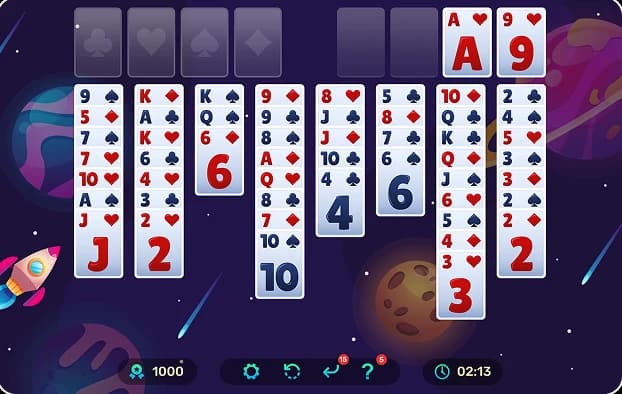
Tableau Layout: The tableau has eight columns. The game starts with all the cards being dealt orally in face-up directions in these columns.
Free Cells Explained
There are four free cells placed above the tableau. Each free cell can hold only one card at a time. Free cells act as temporary storage to help move cards around, especially if you are already familiar with FreeCell Solitaire Rules.
Foundation Piles: There are four foundation piles, one for each suit. These piles start empty and are filled during the game.
Baker’s Game Layout Diagram Explanation
The top area of the layout contains the free cells and foundation piles. Below them are the tableau columns where most of the gameplay happens.
Differences Between Baker’s Game and FreeCell Setup
The setup looks similar to FreeCell, but the rules for building cards in the tableau are stricter in Baker’s Game.
Baker's Game Solitaire Rules Explained
Knowing the rules clearly is key to playing well.
Tableau Building Rules: Tableaus are constructed down by suit. For example, a seven of hearts can be placed only on an eight of hearts.
Foundation Rules: Foundations are constructed in Ace to Kings in the same suit. Cards should have the appropriate sequence.
Free Cell Rules: Each free cell can hold only one card. Free cells should be used carefully and not filled too quickly.
Same Suit Building Rule: This rule is what makes Baker’s Game harder than FreeCell. Since only the same suit cards can be stacked, players must think ahead to avoid blocking important cards, which requires even more planning than a typical FreeCell Strategy.
Empty Column Rules in Baker’s Game: Empty tableau columns can accept any single card. However, because of the same suit building, empty columns must be used wisely.
How to Play Baker’s Game Solitaire Step by Step

If you are learning how to play Baker’s Game solitaire, follow these steps to get started.
Step One: Review the Initial Deal
Look over the tableau before making any moves. Identify Aces, low cards, and possible suit sequences.
Step Two: Move Aces to Foundations
Move Aces to the foundation piles early if it does not block other useful moves. This helps create space and keeps the board flexible, which is also important when learning How to Win FreeCell Game situations that depend on careful planning.
Step Three: Build Same Suit Sequences
Focus on building clean sequences of the same suit in descending order. This frees important cards and opens new moves.
Step Four: Use Free Cells Carefully
Do not fill all free cells too early. Always try to keep at least one free cell open for flexibility.
Step Five: Clear Columns Strategically
Empty columns are powerful tools. Use them to move and rearrange long suit sequences when needed.
Step Six: Complete All Foundations
Once the board is under control, move cards steadily to the foundation piles to finish the game.
Legal Moves in Baker’s Game
Understanding legal moves helps avoid mistakes and wasted turns. You can move one card at a time between tableau columns, free cells, and foundations, following the rules. You cannot place cards of different suits in the tableau, or move cards to the foundations out of order.
Legal Tableau Moves: Cards can be placed only on a higher rank card of the same suit.
Legal Free Cell Moves: Any single card can be moved to an empty free cell.
Legal Foundation Moves: Only the next correct card in sequence can be placed on a foundation pile.
Winning Strategies for Baker’s Game Solitaire

Winning Baker’s Game requires patience and smart planning, just like other Types of FreeCell Games.
Free Low Cards Early: Try to free Aces, twos, and threes early. These cards help unlock foundation moves.
Keep Free Cells Available: Always protect your free cells. Open free cells allow you to rearrange cards safely.
Avoid Blocking Same Suit Runs: Since there is only one place for each suit sequence, blocking a run can stop progress completely.
Delay Moving Cards to Foundations: Unlike FreeCell, moving cards to foundations too early can hurt your game. Sometimes keeping cards in the tableau gives more flexibility.
Plan Multi Move Sequences: Think several moves ahead before acting. Baker’s Game rewards careful planning over quick decisions.
Conclusion
Baker’s Game Solitaire is a rewarding card game for players who enjoy deep thinking and careful planning. While it looks similar to FreeCell, the same suit-building rule makes it more challenging and skill-focused. By learning the setup, understanding the rules, and applying smart strategies, players can improve their chances of winning and enjoy a richer solitaire experience.
FAQs
- Yes, Baer’s Game is harder because cards must be built by suit. Beginners often find it more challenging than FreeCell.
- Yes, any single card can be placed into an empty column. However, using empty columns wisely is very important.
- Not every game can be solved. Still, good planning and careful moves greatly increase the chances of winning.

FreeCell.game vs Other FreeCell Websites: Best Comparison
FreeCell.game vs other FreeCell websites compared by speed, ads, mobile support, solvers, and numbered deals. Discover the best FreeCell site online.

Card Games vs Board Games: Which Trains Your Brain Better ?
Discover whether card games or board games provide better brain training for memory, focus, strategy, and problem-solving.

Why More People Are Switching From Offline FreeCell to Online Play
Find out why players are moving from classic desktop FreeCell to browser-based play and what online versions offer today.

Is FreeCell More Popular in the US or the UK? What the Data Says
Compare FreeCell popularity in the US and UK using search volume, per-capita data, and player interest.

Is Every Game of FreeCell Winnable? Strategy & Tips
Is every game of FreeCell winnable? Learn the truth behind FreeCell solvability, why most games can be won, and what makes some deals impossible.