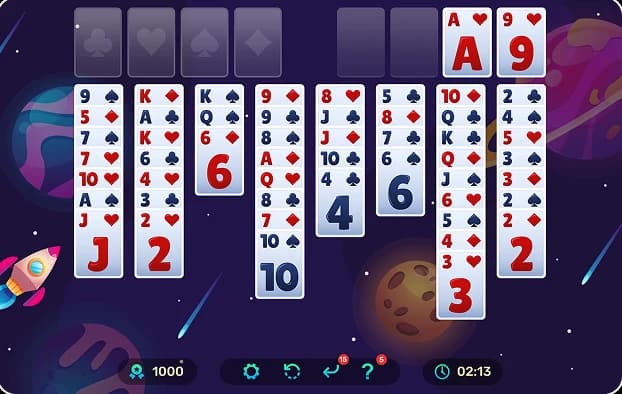
FreeCell Strategy: Win More Games With Smart, Simple Tactics


The ultimate freecell strategy relies on three rules: keep at least two free cells open, move Aces and Twos early, and prioritize clearing empty columns. Because over 99.999% of deals are winnable, games are lost to rushed moves rather than bad luck.
Before you learn, you should know how to Play FreeCell Online or on the PC, which will give you a better chance of winning most games, and also understand the strategies.
Table of contents
- Understanding FreeCell Basics
- What Is the FreeCell Win Rate?
- Core Principles of an Effective FreeCell Strategy
- Step-by-Step FreeCell Strategy to Win More Games
- Advanced FreeCell Strategy for Tough Deals
- Common FreeCell Mistakes (And How to Avoid Them)
- FreeCell Tips for Winning Hard or Complicated Deals
- FreeCell Variants Worth Knowing
- Example Walkthrough: Applying a Real FreeCell Strategy
- Final Thoughts – Master FreeCell With Smart Strategy
Understanding FreeCell Basics

Understanding FreeCell Basics means understanding how the game's three main parts work together. These are important parts that let you know How to Play FreeCell.
The tableau is the area with eight columns where all the cards start, and you build sequences by placing cards in alternating colors.
The free cells are four small spaces where you can place single cards for short-term help while rearranging the board.
The foundation is where you move cards from Ace to King for each suit. Since all cards are visible from the beginning, winning depends on the choices you make. Once you understand how these three areas connect, planning and controlling the game becomes easier.
This full visibility from the start is exactly why so many players lean toward one side when debating is solitaire a game of luck or skill, since nothing about the deal stays hidden once play begins.
What Is the FreeCell Win Rate?
Theoretical solvability is nearly 100%, but the actual casual player win rate sits much lower around 33%. In the classic Microsoft 32,000 deal collection, every single game was solvable except for deal #11982. This massive gap between potential and reality proves that FreeCell is a game of pure skill rather than luck. If you lose a match, it is almost always because of a tactical misstep rather than a bad shuffle.
Core Principles of an Effective FreeCell Strategy
There are four core principles for the freecell strategy that will make Every FreeCell Game Winnable.
Use Free Cells Carefully (Avoid Filling Too Early)
Free cells are not permanent storage. Their purpose is to help you move cards around when building sequences. When you fill them too fast, you lose the ability to make longer, more complex moves.
Prioritize Creating Empty Columns
Empty columns are extremely powerful. You can shift entire sequences there and rebuild the tableau more efficiently. Think of empty columns as super tools that make difficult moves possible. This principle becomes even more critical in Baker's Game, where suit-only building makes empty columns the difference between a winnable and a stuck position.
Move Low Cards (Aces and Twos) as Early as Possible
Buried Aces and 2s block tableau progress. Freeing low cards early opens up foundation building and creates natural landing spots for higher cards.
Build Foundations Gradually
Moving cards to the foundation too quickly may limit flexibility. Only move cards when doing so opens new possibilities in the tableau without trapping needed sequence connectors.
Step-by-Step FreeCell Strategy to Win More Games

Step 1 – Scan the Tableau Before Your First Move
Start every game by scanning the tableau. Look for:
- Buried low cards
- Unbalanced color stacks
- Opportunities for quick sequences
- Columns that can be cleared
A small moment of planning prevents major problems later.
Step 2 – Use Smart Tableau Building (Alternate Colors and Balanced Stacks)
Keep your tableau balanced by building sequences in alternating colors. Avoid stacking many same-color cards together because they limit your ability to move sequences.
Step 3 – Maintain Free Cells While Creating Space
A good habit is to keep at least two free cells empty whenever possible. Free cells should only be used for short-term moves. The more open spaces you have, the easier it is to manage your board.
Step 4 – Master Multi-Card Movement (The Supermove Formula)
Many players do not know that you can move more than one card at a time using the standard formula: Movable Cards = (Free Cells + 1) multiplied by 2 to the power of Empty Columns. For example, with 2 free cells and 1 empty column, you can move (2 + 1) multiplied by 2 to the power of 1, which equals 6 cards at once. Modern digital apps simplify this using a "Supermove," which is an automatic sequence transfer that handles the math for you.
Use this formula:
Movable sequence = (Free Cells + 1) multiplied by (Empty Columns + 1)
This formula helps you understand the level of flexibility you have in tight situations.
Mastering this formula is one of the biggest secrets behind achieving the Fewest Moves in FreeCell, because efficient multi-card movement dramatically reduces unnecessary steps.
Step 5 – Manage Kings Carefully
Kings should only be placed in empty columns when doing so helps move other pieces. A King in the wrong place can block progress and slow your game.
King placement decisions like this come up constantly once you move beyond FreeCell into broader guides on how to win solitaire, since Klondike and other variants share this exact same empty-column dilemma.
Advanced FreeCell Strategy for Tough Deals

Think Several Moves Ahead
FreeCell rewards people who plan. Try to picture what will happen after each move. Good players often think two or three steps forward to avoid deadlocks.
Avoid Locking Key Cards Under High Cards
Do not bury low-value cards like Aces and Twos under long stacks. These cards are essential for opening the foundation and clearing space.
Sequence Cycling (Advanced Card Reordering Trick)
Sequence cycling involves using free cells and empty columns to break and reorder sequences more efficiently temporarily. This helps you fix messy columns and create smoother paths.
Common FreeCell Mistakes (And How to Avoid Them)
Review these common errors and their fixes to stop losing matches to simple blunders.
| Common Mistake | Why It Loses Games | The Fix |
|---|---|---|
| Filling free cells too early | Leaves zero room to execute sequence transfers. | Keep at least two free cells completely empty. |
| Sending cards to foundations too fast | Removes useful building blocks needed for middle tiers. | Follow the Safe Auto-Play Rule and keep low cards on the board if they act as connectors. |
| Leaving low cards buried | Locks up foundation progress early. | Prioritize freeing Aces and Twos above all else. |
| Placing Kings blindly in empty columns | Wastes empty tableau columns that double transfer power. | Only use empty columns for Kings if it unlocks a major card stack. |
| Building long same-color stacks | Traps cards and prevents sequence shifts. | Always alternate card colors when building tableau columns. |
FreeCell Tips for Winning Hard or Complicated Deals

Hard games require patience and a little creativity. Here are some helpful free cell strategies and tips to simplify difficult layouts:
- Use Undo and Redo to explore different paths: Test alternative sequence paths to see which branch opens up the tableau best.
- Restart deals that begin with extreme blockages: Analyze what went wrong and try a fresh opening sequence.
- Keep an eye out for patterns in tough layouts: Group same-rank cards mentally before shifting.
- Clear one or two columns early for mobility: Focus all initial moves on emptying a single tableau column.
- Adjust sequences often to maintain flexibility: Do not let sequences sit stagnant if shifting them opens up buried low cards.
These tricks help you regain control even when the board looks messy. Many players practice these difficult deals regularly on mobile, and most of the Top FreeCell Apps already include hard levels, daily challenges, and unlimited undo options that make improving much easier.
FreeCell Variants Worth Knowing
Explore these popular twists on the classic game to test your logic skills in new ways.
- Baker's Game: This version uses the exact same layout as classic FreeCell, but sequences must build down by suit rather than alternating colors. Because suit restrictions are tighter, creating empty columns becomes critical to your success.
- Eight Off: This variant features eight free cells and four pre-filled foundation spaces at the start of the game. Cards build down in same-suit descending sequences, giving you massive storage room at the cost of strict placement rules.
- Easy FreeCell: Designed for beginners, this variant places all four Aces and twos directly onto the foundations at the start of the deal. It removes early game friction and lets you practice mid-game stacking without getting stuck immediately.
Example Walkthrough: Applying a Real FreeCell Strategy

FreeCell Games for the Brain are a great exercise, and using this strategy can help you develop it.
Let’s imagine a deal where:
- Aces are deep in the tableau
- You have no empty columns
- Two stacks are built heavily on the same color
An innovative approach looks like this:
- Free the Aces by temporarily placing blocking cards in free cells.
- Balance colors across columns to increase movement.
- Create your first empty column using careful cycling.
- Shift a long sequence into that empty space.
- Now move the freed low cards to the foundation.
- Repeat the method to open more space and clear blocking cards.
Each move improves the board by creating flexibility and avoiding traps. This is the foundation of a good freecell solitaire strategy.
Final Thoughts – Master FreeCell With Smart Strategy
To excel at playing FreeCell, you need to be patient, plan ahead, and move smoothly. This way, you will be able to cope with challenging layouts, finish games quicker, and make sense of everything that happens in the game.
Work on your techniques regularly, and you'll find yourself building up the perfect FreeCell strategy. Whether you play just for pleasure or take your gameplay seriously, becoming a professional player adds even more enjoyment to the game.
FAQs
- Almost every deal is solvable. In Microsoft's original 32,000-game collection, only one deal (#11982) is mathematically impossible. Over 99.999% of deals can be won with optimal strategy.
- Focus on keeping free cells open, freeing Aces quickly, and avoiding long stacks of the same color.
- It's important to try to leave at least two spaces free whenever possible to ensure clarity and organization in your work or environment.
- To regain control of the game, undo moves when necessary, free low cards for better combinations, and clear a column to create space for strategic plays. These tactics will enhance your chances of success.
- The most challenging Freecell game is the deal 11982, which is an unwinnable game brought by the Microsoft Freecell collection.

FreeCell.game vs Other FreeCell Websites: Best Comparison
FreeCell.game vs other FreeCell websites compared by speed, ads, mobile support, solvers, and numbered deals. Discover the best FreeCell site online.

Card Games vs Board Games: Which Trains Your Brain Better ?
Discover whether card games or board games provide better brain training for memory, focus, strategy, and problem-solving.

Why More People Are Switching From Offline FreeCell to Online Play
Find out why players are moving from classic desktop FreeCell to browser-based play and what online versions offer today.

Is FreeCell More Popular in the US or the UK? What the Data Says
Compare FreeCell popularity in the US and UK using search volume, per-capita data, and player interest.

Is Every Game of FreeCell Winnable? Strategy & Tips
Is every game of FreeCell winnable? Learn the truth behind FreeCell solvability, why most games can be won, and what makes some deals impossible.