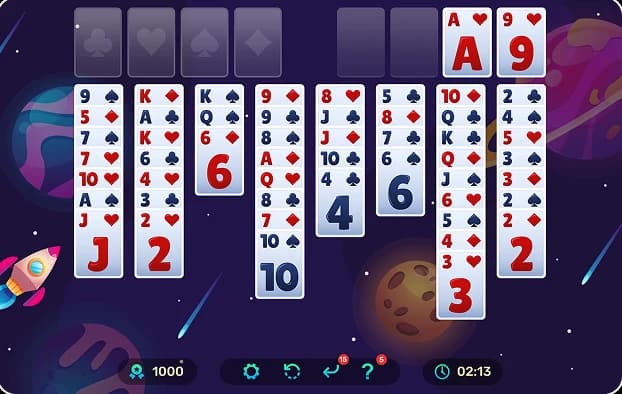
FreeCell.game vs 247 FreeCell — Which Is Better in 2026?


For casual gamers and card puzzle purists alike, web-based solitaire is the ultimate friction-free distraction. You do not want to download a heavy app, sit through unskippable video ads, or register an account just to play a quick 5-minute hand.
Two massive platforms dominate browser-based play: FreeCell.game and 247 FreeCell. While both offer the classic 52-card setup where 99.999% of deals are mathematically winnable, they approach user experience from completely different design philosophies.
This head-to-head comparison looks at how these two platforms perform across modern devices, focusing on UI speed, ad intrusion, state persistence, and mechanical responsiveness.
Table of contents
FreeCell.game vs 247FreeCell.com: Head-to-Head Overview
| Feature | FreeCell.game | 247 FreeCell |
|---|---|---|
| Primary Focus | Hyper-minimalist UX, maximum speed | Varied game modes, retro style |
| Control Engine | Smart tap-to-move and fluid drag | Traditional drag-heavy layout |
| Mobile Performance | Fully responsive, fast asset loading | Heavy scrolling required on small screens |
| Session Persistence | Auto-saves background state instantly | High risk of state loss on page refresh |
| Ad Layout | Non-intrusive peripheral banners | Intrusive interstitial placements |
Interface and Visual Design: Minimalist vs. Classic Nostalgia
FreeCell.game: Modern UX and Speed
FreeCell.game is built for speed. The interface behaves like a progressive web application rather than a traditional webpage. The background assets are clean, focusing entirely on high-contrast card readability and rapid canvas rendering. There are no heavy sidebar widgets or redundant text elements cluttering the board, allowing the game board to scale perfectly across diverse screen sizes. This makes it an ideal platform for beginners who are still learning the basic FreeCell strategy, as the clean field of view highlights open pathways without distracting clutter.
247 FreeCell: The Retro, Desktop-First Aesthetic
247 FreeCell relies heavily on nostalgia. Its green felt backdrop and thick card designs mimic early desktop operating system variations. While charmingly nostalgic for players who grew up on classic desktop solitaire, the site layout feels distinctly fixed. The surrounding page contains extensive text blocks and external navigation links that clutter the visual field and can distract from active puzzle-solving.
Core Features and Quality of Life Mechanics
Move Engine: Tap-to-Move vs. Drag-and-Drop
The mechanical engine running underneath the cards dictates your speed-run potential. FreeCell.game utilizes an intelligent pathfinding move engine. Tapping a card automatically sends it to the most logical location, whether a foundation pile or an available cascade. It handles super moves elegantly, instantly calculating if you have enough open free cells and empty columns to clear a sequence. If you are learning how to play FreeCell at a faster pace, this automated pathfinding prevents tedious dragging mistakes.
247 FreeCell relies more heavily on deliberate drag-and-drop mechanics. While it supports basic click movements, the precision required is strict. If you prefer to manually control every micro-movement of your stack, the deliberate pacing here feels comfortable, though it slows down fast-paced play.
State Persistence: Do You Lose Your Progress on Refresh?
Nothing ruins a game faster than an accidental browser refresh or an incoming phone call closing your tab mid-puzzle. For players digging through the best solitaire websites to play online, data persistence is a critical performance metric. FreeCell.game uses aggressive local storage caching to preserve your game board state in real-time. If the page reloads, your game picks up exactly where you left off. 247 FreeCell often struggles with this level of persistence, frequently forcing a fresh redeal if the browser session drops from active memory.
Solvability and Game Modes
If you want variety, 247 FreeCell shines by offering unique alternative modes directly on their domain, including 1, 2, and 3 FreeCell challenges that alter the mathematical difficulty of the game. FreeCell.game instead focuses on mastering the pure, standard 4-cell classic format, optimizing the engine specifically for that layout. This dedicated focus maximizes the benefits of freecell as a tool for stress relief, ensuring players experience a smooth, predictable environment where logic always triumphs over random layout luck.
The Elephant in the Room: Ad Friction and Performance
Browser-based gaming requires monetization, but the method matters immensely to the end-user experience. FreeCell.game handles monetization through static, peripheral ad banners. These ads sit outside the active playing canvas, ensuring they never block cards or trigger accidental clicks. The layout prevents visual shifting, which keeps the card columns completely stable during gameplay.
247 FreeCell features a heavier ad footprint. Interstitial ads can disrupt transitions between games, and the placement of banner ads can occasionally push the game board off-screen on certain browser resolutions. This layout increases the risk of misclicks, particularly on mobile devices.
Mobile Browser Optimization: Playing on the Go
Playing a quick hand on a phone changes the technical requirements completely. FreeCell.game scales down into a vertical or horizontal mobile aspect ratio seamlessly. The card margins expand dynamically, and the top-level free cells adjust so they can be easily tapped with a thumb. This flawless scaling makes it incredibly simple to pull up a quick game regardless of your device.
247 FreeCell feels restricted by its desktop-first design legacy on mobile devices. The site requires frequent zooming or manual scrolling to align the columns on smaller screens. The dense text and navigation links surrounding the game board take up valuable real estate, leaving less room for the cards themselves. This layout friction can quickly frustrate players who simply want a smooth single player card games experience while commuting or waiting in line.
Final Scoreboard: Which Platform Deserves Your Bookmark?
Your choice ultimately depends on what you value most in your daily gaming routine:
- Choose FreeCell.game: You want a clean, lightning-fast puzzle interface with smart-move logic, excellent mobile optimization, and zero gameplay interruptions. It is the superior platform for daily players looking to maximize their wins per hour while testing their skills against standard deals without running into notoriously unwinnable freecell games.
- Choose 247 FreeCell if: You are looking for variant challenges like 1-cell or 2-cell setups, or if you prefer a retro, green-felt aesthetic that mirrors classic desktop versions. Knowing the standard FreeCell game rules helps across both, but FreeCell.game wins on raw modern performance.
FAQs
- No. While both platforms follow the standard rules of classic FreeCell, they use different random number generators (RNG) and deal seeding engines. FreeCell.game uses a modern algorithm optimized to ensure you get clean, standard setups. 247 FreeCell utilizes its own distinct legacy pool of deals, which is why a specific deal number on one site will not match the layout of that same number on the other.
- FreeCell.game has a significant advantage here due to its progressive architecture. Once the assets load in your browser tab, the core game engine can run without an active internet connection, meaning your game won't freeze if you hit a cellular dead zone. 247 FreeCell requires a continuous connection to reload its script elements, fetch ads, and transition between new game deals.
- FreeCell.game generally bypasses network filters more easily because it is a single-purpose, lightweight domain without a massive footprint of external tracking scripts. 247 FreeCell is a highly recognized gaming hub, meaning its domain is frequently pre-blacklisted by corporate and school network administrators looking to block casual gaming sites.
FreeCell.game vs Other FreeCell Websites: Best Comparison
FreeCell.game vs other FreeCell websites compared by speed, ads, mobile support, solvers, and numbered deals. Discover the best FreeCell site online.

Card Games vs Board Games: Which Trains Your Brain Better ?
Discover whether card games or board games provide better brain training for memory, focus, strategy, and problem-solving.
Why More People Are Switching From Offline FreeCell to Online Play
Find out why players are moving from classic desktop FreeCell to browser-based play and what online versions offer today.

Is FreeCell More Popular in the US or the UK? What the Data Says
Compare FreeCell popularity in the US and UK using search volume, per-capita data, and player interest.

Is Every Game of FreeCell Winnable? Strategy & Tips
Is every game of FreeCell winnable? Learn the truth behind FreeCell solvability, why most games can be won, and what makes some deals impossible.