FreeCell vs Solitaire: Which Card Game Should You Play?


Although both of them can be classified as classic patience games, the basic difference between freecell and Solitaire lies in the aspect of transparency and luck. In FreeCell, all cards are dealt face-up, and there are four free reserve spots that make most of the games almost winnable using pure skill.
Card games have been a favoured activity for generations, with FreeCell and Solitaire being two of the most popular. While both fall under the category of patience games, their gameplay, rules, and techniques differ greatly. This guide compares Freecell vs Solitaire, showing their unique features, win rates, and which game could be better for you. You can Play FreeCell Online now, and also Solitaire with all the different variations.
Table of contents
- Similarities Between FreeCell and Solitaire
- Key Differences Between FreeCell and Solitaire
- FreeCell vs. Klondike Solitaire: Which Is Harder?
- FreeCell vs. Spider Solitaire: What's the Difference?
- What Do People Mean by "Solitaire" and "FreeCell"?
- Why Does This Comparison Matter Between FreeCell and Solitaire?
- What is Solitaire and What are the Basic Rules To Play
- What is FreeCell: Gameplay Guide, Strategy and Types?
- Key differences between FreeCell and Solitaire
- Which Should You Play: FreeCell or Solitaire?
- Conclusion
Similarities Between FreeCell and Solitaire
FreeCell and Klondike Solitaire share core structural foundations despite their distinct mechanics. Both games use a standard 52-card deck, require players to build four foundation piles from Ace up to King by suit, and utilize tableau columns where cards are built down in alternating colors. Furthermore, both titles belong to the broader solitaire family of single-player puzzle games designed to test patience and card management.
Key Differences Between FreeCell and Solitaire
| Feature | FreeCell | Klondike Solitaire | Spider Solitaire |
|---|---|---|---|
| Deck Count | 1 Deck (52 cards) | 1 Deck (52 cards) | 2 Decks (104 cards) |
| Face-Up Cards | 100% visible from start | Partially hidden tableau | Partially hidden tableau |
| Stockpile | None | Yes | Yes (Deals new rows) |
| Free Cells | 4 open reserve spaces | None | None |
| Sequence Rules | Alternating color, strict limits | Alternating color | Same suit building |
| Win Rates | >99% (Pure skill) | 5% - 20% (Luck dependent) | Varies by suit difficulty |
| Game Length | Medium to long planning | Short to medium | Long and complex |
- Face-up cards: FreeCell displays every single card right at the start, whereas Klondike hides cards in face-down tableau stacks.
- Sequence movement limits: FreeCell strictly calculates how many cards can shift at once based on open free cells and empty columns, while Klondike allows moving any valid built sequence.
- Luck factors: FreeCell removes luck entirely since all information is public, while Klondike leaves outcomes heavily at the mercy of the random card draw.
- Stockpile usage: FreeCell has no backup draw pile, forcing you to manage your starting layout carefully.
- Empty column rules: FreeCell restricts empty column placement exclusively to Kings, whereas Klondike permits any card or sequence to fill an empty slot.
FreeCell vs. Klondike Solitaire: Which Is Harder?
Klondike is more difficult to play because luck cannot be avoided when there are hidden cards and random card drawing. On the other hand, FreeCell is more difficult to play as it requires extensive strategic thinking. As all the cards can be seen from the start in FreeCell, your losses are due to errors in strategy and not luck. Read more about this math in our article Is Every Game of FreeCell Winnable.
FreeCell vs. Spider Solitaire: What's the Difference?
In Spider Solitaire, there are two complete decks of cards arranged in ten tableau piles where one needs to arrange cards in descending order having the exact suit, which can be made difficult in 1, 2, or 4 suit modes. Whereas in FreeCell, only one deck is used in eight tableau piles with four free cells, and no stock pile replenishment is allowed.
What Do People Mean by "Solitaire" and "FreeCell"?

When people mention "Solitaire", they usually mean Klondike Solitaire, the classic version that came with early computers. On the other side, FreeCell is a distinct variation with an open-tableau architecture. So the comparison between solitaire and freecell is more than simply two names; it is also a comparison of two distinct games.
Why Does This Comparison Matter Between FreeCell and Solitaire?
The main distinction is between skill and luck. Classic Solitaire focuses on card order and hidden cards, whereas FreeCell emphasises planning and strategy because all cards are revealed from the start. Understanding the differences between freecell vs solitaire allows players to select a game that best suits their playing style.
Beyond this comparison, many players also evaluate broader gameplay styles when choosing between card games or board games, especially when deciding between solo and group-based experiences.
What is Solitaire and What are the Basic Rules To Play
Solitaire is a one-player card game where you stack cards in alternating colors and build suits from Ace to King. It’s easy to learn but requires strategy and patience. There are various types of Solitaire, each with distinct rules.
Rules and Gameplay Overview
In Solitaire (Klondike), the deck is mixed and dealt into a tableau, some cards facing down. You build alternating-colour sequences with the goal of moving all cards to the foundation piles, which are arranged by suit from Ace to King. The stockpile and garbage pile enhance difficulty as you flip through cards to find playable possibilities.
Hidden Cards and Variants
Solitaire is famed for its hidden cards, giving each game a combination of skill and luck. Players can select "Turn 1" (drawing one card at a time) or "Turn 3" (drawing three cards at once), with the latter increasing difficulty.
To explore the evolution of Solitaire from early card decks to the digital era, read "Solitaire of History: Origins and Evolution of the Classic Card Game," a fascinating look at how this timeless brain game became a global favorite.
What is FreeCell: Gameplay Guide, Strategy and Types?
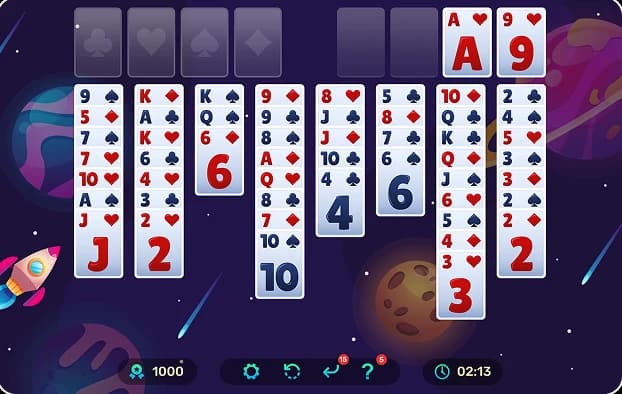
FreeCell is a strategic version of Solitaire where all cards are dealt face up from the start.
You use four “free cells” as temporary spots to move cards while building sequences in alternating colors from Ace to King.
It’s a skill-based game with almost every deal winnable. Play FreeCell online to sharpen your logic and focus while enjoying a true test of strategy.
FreeCell Types
There are many Types of FreeCell Games out there, from the most famous Classic FreeCell to a very lesser-known Multi-Stage FreeCell variation, but all of them are different and fun to play.
Full Face-Up Tableau
In FreeCell, each card is dealt face up at the start. Because nothing is hidden, the game is heavily reliant on ability. You have four "free cells" in which single cards can be temporarily held, allowing you to modify sequences.
Different Moves
Unlike Solitaire, FreeCell has more strict rules for moving cards. Vacant columns can only be filled with Kings, and the number of cards that can be moved at once is determined by the number of free cells and vacant spaces available. These dynamics make freecell versus spider solitaire and other comparisons particularly appealing to strategy-oriented players.
Key differences between FreeCell and Solitaire

Tableau Visibility and Hidden Cards
- Solitaire: Hidden cards make the outcome unpredictable.
- FreeCell: All cards are displayed, allowing for complete planning.
Use of Free Cells/Open Spaces
- Solitaire: There are no free cells; gaming is based on waste and stock heaps.
- FreeCell: Four free cells provide strategic versatility.
Sequence Movement Constraints
- Solitaire: It moves whole sequences if the rules allow.
- FreeCell: Movement is limited to a predetermined number of cards based on open cells.
Empty Column Rules
- Solitaire: It allows any card to fill an empty slot.
- FreeCell: Only Kings can occupy empty tableau columns.
Impact of Luck vs Skill
- Solitaire: It relies on both luck and ability to succeed.
- FreeCell: It is almost entirely skill-based; with flawless play, most games are winnable with the right FreeCell Strategy.
Tools, Data, and Win Rates
Statistical Data:
Solitaire (Klondike): The estimated win rate ranges from 5 to 20%, depending on the regulations.
FreeCell: More than 99% of games are theoretically winnable. That is why if anyone asks if Every Game of FreeCell Is Winnable, you can say no, but 99% are.
Solvers and Simulators
Researchers have confirmed that nearly every FreeCell transaction can be resolved with the right method. Solitaire's conclusion is far less predictable.
Digital Features
Hints, undos, and autoplay are frequently available in online versions of both games, providing casual players with a more equal chance while maintaining the challenge. For FreeCell specifically, the platform you choose matters just as much as the features it offers, which is why the FreeCell.game vs 247 FreeCell debate is worth exploring before settling on one site.
Which Should You Play: FreeCell or Solitaire?
For those who appreciate logical problem-solving, long-term forward planning, and fairness based on skill level in the game, choose FreeCell. Those desiring entertainment and casual play that involves faster card drawing should go for Klondike Solitaire. In summary, those who love strategy should choose FreeCell while the rest should opt for Solitaire.
Practice suggestions: Try out both games. First, start by playing Solitaire as entertainment before moving on to FreeCell as a way to enhance one’s strategic capabilities. This can be seen as an interesting variation in place of Spider Solitaire versus Freecell for advanced players seeking variation in their gaming. TriPeaks Solitaire is a good example.
Conclusion
FreeCell vs Solitaire boils down to whether you like skill-based challenges or luck-based variation. Solitaire keeps you guessing with concealed cards and many variations, whereas FreeCell rewards intelligent preparation with open information and almost assured solvability. FreeCell Helps Boost Your Brain Health.
Whichever you choose, both games provide ageless entertainment. Try both versions now, fine-tune your methods, and see which one best suits your style.
FAQs
- No. Solitaire typically refers to Klondike, although FreeCell is a distinct game with an open tableau and free cells.
- FreeCell is more strategic but more equitable because most games are solved. Solitaire has a higher degree of unpredictability because many deals are impossible to win.
- FreeCell has a far greater win rate (over 99% solvable) than Solitaire, which is 5-20%.
- If you're new, begin with Solitaire for casual gaming. If you want to develop a great card-game strategy, try FreeCell afterwards.
FreeCell.game vs Other FreeCell Websites: Best Comparison
FreeCell.game vs other FreeCell websites compared by speed, ads, mobile support, solvers, and numbered deals. Discover the best FreeCell site online.

Card Games vs Board Games: Which Trains Your Brain Better ?
Discover whether card games or board games provide better brain training for memory, focus, strategy, and problem-solving.
Why More People Are Switching From Offline FreeCell to Online Play
Find out why players are moving from classic desktop FreeCell to browser-based play and what online versions offer today.
Is FreeCell More Popular in the US or the UK? What the Data Says
Compare FreeCell popularity in the US and UK using search volume, per-capita data, and player interest.

Is Every Game of FreeCell Winnable? Strategy & Tips
Is every game of FreeCell winnable? Learn the truth behind FreeCell solvability, why most games can be won, and what makes some deals impossible.